

The Digital Actor's Studio • Segment 06: — Wardrobe, Props & Object Continuity
Some objects don’t just tell stories, they ARE the story.

I mentioned in the last Digital Actor’s Studio, that in Segement 06, we would unpack how to track and anchor recurring physical visual cues across your entire timeline — how to maintain object continuity without a continuity supervisor on set, and why that oil-stained ceramic workshop mug sitting inside a flawless MasterCraft cup holder is the single most important storytelling choice you will make in this production.
Texture builds credibility.
Artifacts build history.
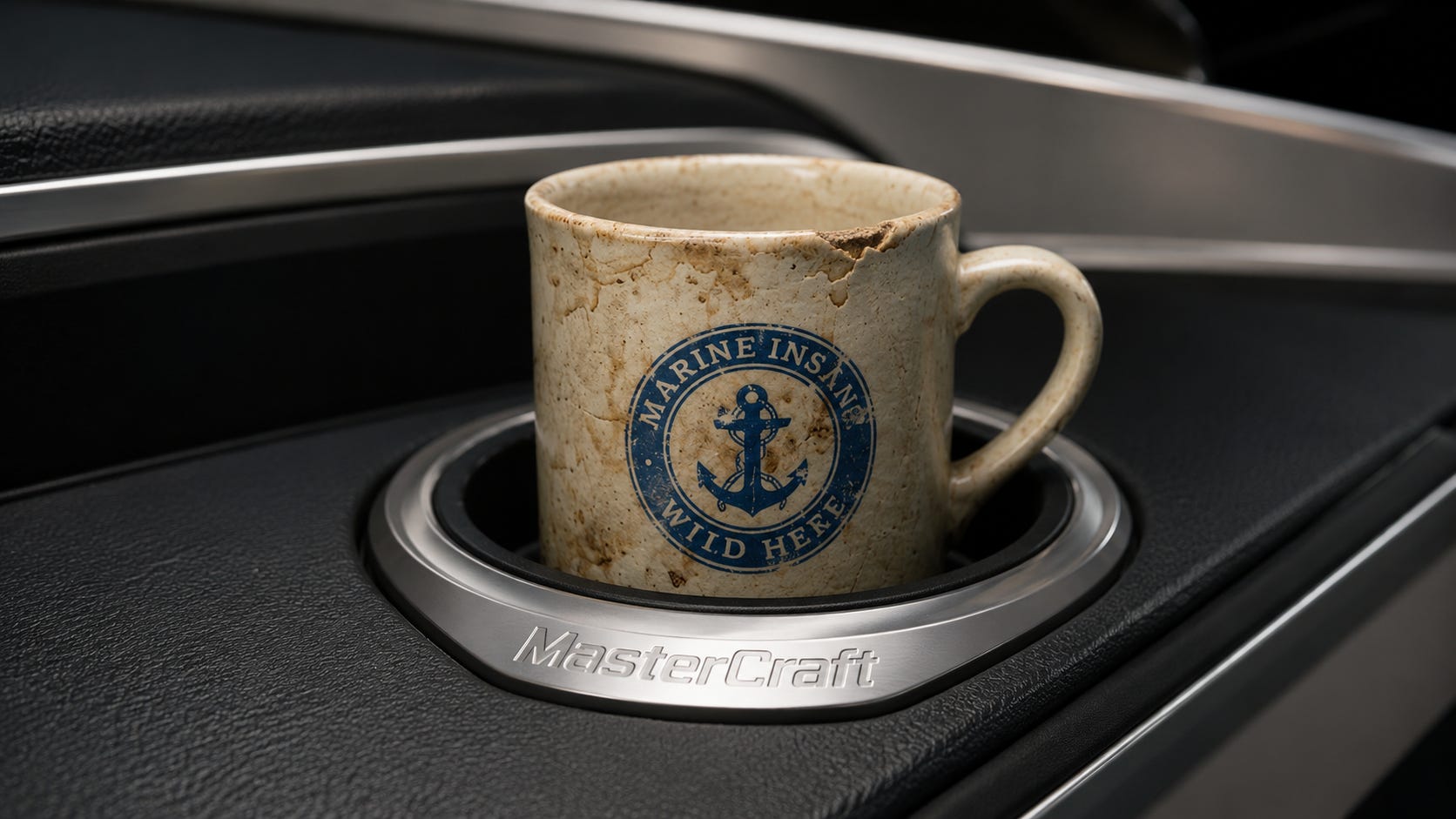
The Manifestation of the Craft
I want to pause and clarify before we take another step (or read another line of copy).
Right now, the internet is completely flooded with copy-paste prompt solutions. People are constantly looking for a lazy, automatic checkbox to build characters.
‘Don’t add to my labors, Brian. Just give me the fast track to awesome.’
But in that hustle, people completely miss the point: where does the human-in-the-loop actually show up? When you rely entirely on boilerplate automation, you’ll quickly notice there is almost nothing separating your results from the rest of the noise.
The separation shows up right here… in the details.
The machine is incredibly efficient at rendering a clean, generic asset—the kind of pristine “IKEA catalog” world that populates empty AI influencer feeds. But a copy-paste prompt cannot track memory. It doesn’t know that a stained, chipped ceramic mug carries thirty years of a builder’s rough history.
Knowing the craft means understanding the exact visual friction required to make a story more real, more believable, and most importantly—more relatable. When you intentionally force a digital asset to carry a worn wardrobe anchor or a persistent flaw across completely different settings, you aren’t just prompting; you are directing meaning. You are leaving human fingerprints on a digital canvas.
The Architecture of the Human Fingerprint
Let’s hit the highlights from what we have covered up to today in this series, looking closely at how we have been integrating human-in-the-loop details all along the way:
Segment 01 • Character Bible • Visual DNA (Character): We didn’t build a flawless model face. We deliberately broke the symmetry of the engine and injected a visual “tell”—specifically engineering Brad’s deep-set brow worry lines and his eyebrow scar to serve as permanent structural anchors.
Segment 02 • Environmental Storytelling (World): We rejected clean, empty digital backdrops. We layered the stage with three dimensions of biological friction: table scratches, decades of embedded machine grease, and a fine pile of brass shavings that physically exposed a creator’s frustration.
Segment 03 • a • Audio + b • Acting (Performance): We cast aside robotic text-to-speech rendering and flat puppet animations. Instead, we mapped your real vocal stammers and skeletal muscle data directly onto Brad, ensuring his jaw tension and micro-expressions came from an authentic human source.
Segment 04 • Narrative Pacing (Cinematography): We didn’t allow the camera to drift aimlessly. We enforced strict human camera physics and graphic continuity, using Brad’s sharp line of sight to drive the rhythmic collision between his messy workshop past and a clinical showroom future.
Segment 05 • Texture Fidelity & Up-Rendering (Believability): We completely flipped the upscaling script. We didn’t use enhancers to clean or beautify; we used them to anchor the grit—multiplying the visibility of skin pores, fabric weave, and facial blemishes to make his vulnerability undeniable under close inspection.
Which brings us right to the workbench today.
Every visual, acoustic, and cinematic layer we have built so far has been designed to prepare you for the ultimate test of material truth...
